
How to Remove Water Spots from Car Paint
in Dubai Without Damaging the Finish
- Home
- Blogs
Date: 20-Nov-2026 Author: Safalux
Table of Contents
- Why Water Spots Are a Unique Threat in the Dubai Climate
- Assessing the Damage: The Fingernail and Angled-Light Test
- Preparing Your Vehicle for Water Spot Removal in Dubai
- Phase 1: The Chemistry-First Correction
- Phase 2: Mechanical Decontamination for Stubborn Deposits
- Phase 3: Removing Etched Spots Through Machine Polishing
- Advanced Protection: Shielding Your Finish from Dubai's Elements
- Best Practices for Water Spot Prevention in the UAE
- Essential Tools for Maintaining Your Car's Paint
- Professional Water Spot Removal in Dubai: Why Choose Safalux Auto Care?
- Final Thoughts: Keep Your Car's Paint Spot-Free in Dubai
- Frequently Asked Questions About Water Spot Removal
Water spots on car paint are more than an appearance problem. In Dubai, where vehicles face intense sunlight, high temperatures, dust, and frequent exposure to irrigation water, mineral deposits can quickly become stubborn stains. If left untreated, some water spots can etch into the clear coat, affecting your vehicle's gloss and overall finish.
Professional water spot removal helps eliminate hard water stains, restore surface clarity, and protect automotive paint from unnecessary damage. However, the correct treatment depends on whether the marks are mineral deposits sitting on the surface or actual etching within the clear coat.
At Safalux Auto Care, we understand the importance of maintaining your vehicle's exterior. Whether you own a luxury sedan, SUV, sports car, or daily commuter, identifying the correct treatment is essential to preserving its original appearance.
If you are dealing with stubborn water stains, this guide explains their causes, removal methods, prevention techniques, and when to seek professional car detailing in Dubai.
Why Water Spots Are a Unique Threat in the Dubai Climate
Dubai's environmental conditions make automotive paint maintenance particularly important. High temperatures, direct sunlight, airborne dust, and mineral-containing water can contribute to stubborn water stains on vehicle surfaces.
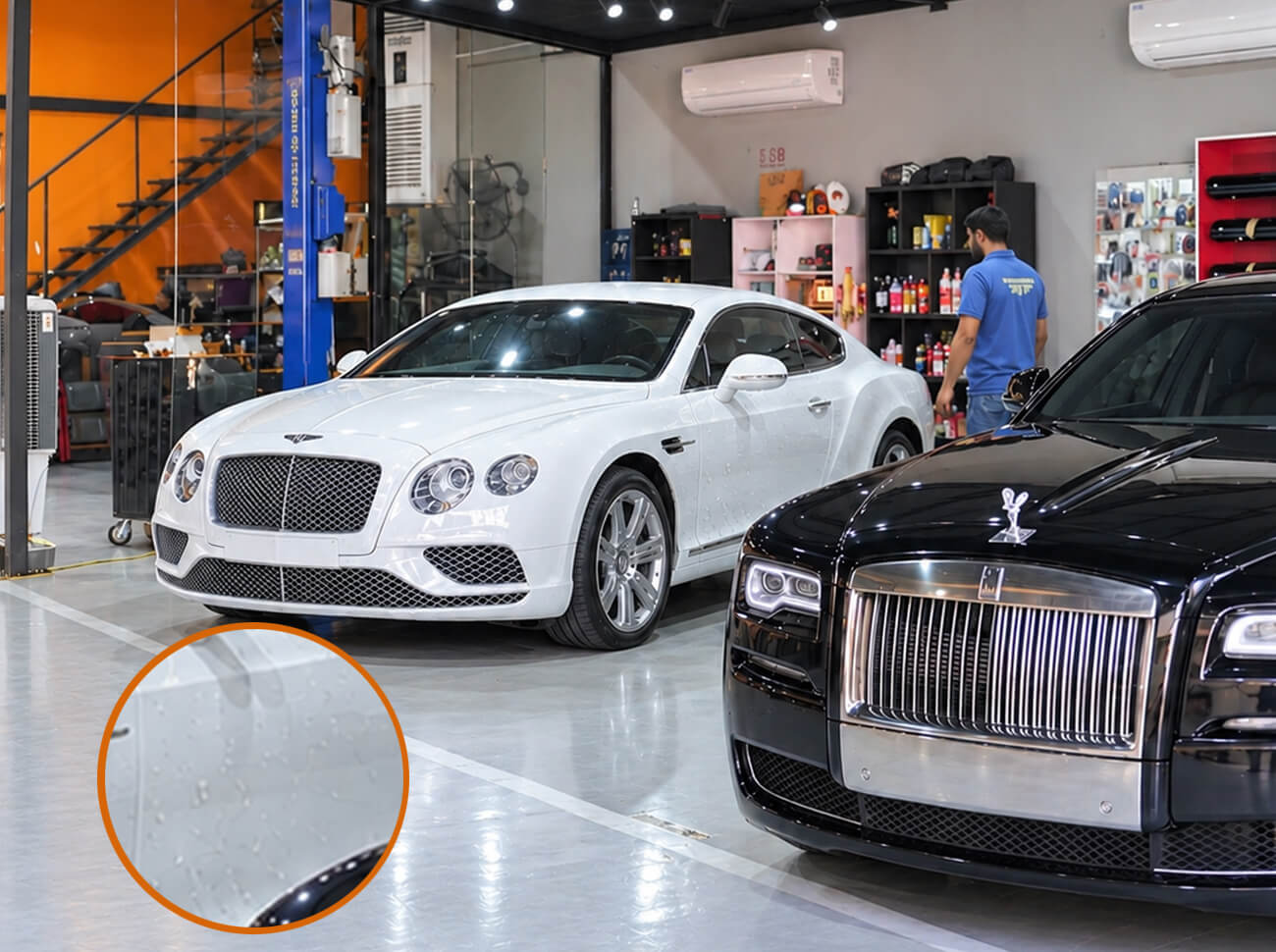
Water spots form when droplets evaporate and leave dissolved minerals and other residue behind. These deposits can create white rings, cloudy patches, or chalky marks across the paintwork.
The Chemistry of Desert Water: Calcium and Magnesium Deposits
Hard water contains dissolved minerals, particularly calcium and magnesium. When water evaporates from your vehicle's exterior, these minerals remain behind as visible deposits.
Common sources include:
- Tap water used during residential car washing.
- Garden hoses and irrigation systems.
- Sprinkler overspray in residential parking areas.
- Water from commercial washing facilities.
- Rainwater mixed with airborne contaminants.
Calcium deposits and other mineral residues can bond to the clear coat, making ordinary washing ineffective.
How Dubai's Extreme Heat Accelerates Mineral Etching
When droplets remain on a hot vehicle panel, evaporation happens more quickly. As the water disappears, dissolved minerals become concentrated in smaller amounts of remaining moisture.
Repeated exposure can make deposits increasingly difficult to remove. Under certain conditions, chemical interactions can also damage the clear coat, leaving permanent-looking circular marks.
There is no guaranteed five-minute threshold for damage. The outcome depends on water composition, surface temperature, exposure time, and existing paint protection.
Desalinated Water vs. Groundwater: Understanding Mineral Content
Dubai relies heavily on desalinated water for its municipal supply, but this does not mean every water source is completely free of minerals.
Water composition can vary depending on treatment, distribution, storage, and the source used for irrigation or washing.
Groundwater and some alternative supplies may contain higher concentrations of dissolved minerals. Regardless of the source, allowing droplets to dry naturally on automotive paint can leave visible deposits.
Assessing the Damage: The Fingernail and Angled-Light Test
Before attempting water spot removal, it is important to understand the condition of the affected surface.
Not all water stains require polishing. Using an abrasive treatment when a simple chemical cleaning would work can unnecessarily remove clear coat.
Start with a clean, dry panel and inspect the affected area under suitable lighting.
Type I Water Spots: Surface Mineral Deposits
Type I water spots are mineral deposits sitting on top of the clear coat.
Typical characteristics include:
- White or chalky circular marks.
- Visible mineral residue after washing.
- Surface deposits that may respond to specialised cleaning.
- No obvious permanent distortion in the paint finish.
These marks can often be treated using an automotive-safe mineral remover without machine polishing.
Type II Water Spots: Etched Marks in the Clear Coat
Type II water spots occur when contamination or chemical exposure has affected the clear coat itself.
They may appear as circular rings, cloudy impressions, or shallow crater-like marks.
Removing the mineral deposit alone will not necessarily remove the remaining defect. The damaged surface may require professional paint correction to restore clarity.
A fingernail test is not a reliable way to determine etching depth. Avoid scraping or pressing hard against the paint. Inspection under angled lighting after proper cleaning provides a better initial assessment.
When to DIY and When to Call a Professional Detailer
DIY cleaning may be suitable for fresh, light mineral deposits when the vehicle is cool, and the correct automotive products are available.
Consider professional treatment when:
- Water spots remain after normal washing.
- White mineral rings cover multiple panels.
- Marks remain after chemical decontamination.
- Your vehicle has a ceramic coating.
- The paint has visible etching or a cloudy finish.
- You are unsure how much clear coat remains.
Professional assessment helps prevent unnecessary abrasion and protects the vehicle's original finish.
Preparing Your Vehicle for Water Spot Removal in Dubai
Proper preparation is essential for safe car water spot removal. Treating dirty or hot paint can increase the risk of scratches, chemical damage, and uneven results.
Timing Your Detail: Early Morning or Late Evening
Avoid washing or treating your vehicle under direct sunlight.
Early morning or late evening can provide more suitable conditions, but a shaded, temperature-controlled workshop is preferable for professional correction.
The vehicle's paint should be cool before any chemical treatment begins.
Creating a Controlled Environment
Dust can settle quickly on vehicle surfaces, especially in Dubai's outdoor environment.
A controlled detailing environment helps reduce contamination during cleaning and polishing.
Professional preparation should include:
- Inspecting the vehicle's paint condition.
- Keeping the panels cool.
- Protecting sensitive exterior trim.
- Using clean microfiber towels.
- Preventing loose dust from contacting treated surfaces.
Thorough Pre-Wash with pH-Neutral Shampoo
Begin with a proper exterior wash using automotive shampoo.
This removes loose dirt, dust, road grime, and other contaminants that could cause scratches during subsequent treatment.
Rinse thoroughly and dry the vehicle with a clean, high-quality microfiber towel.
Never attempt to remove stubborn mineral deposits by rubbing harder against dirty paint.
Phase 1: The Chemistry-First Correction
The safest professional approach is to start with the least aggressive treatment that can effectively remove the contamination.
Why Abrasive Treatment Should Not Be Your First Step
Polishing removes a small amount of clear coat to level surface imperfections. It should not be the automatic solution for every water stain.
If the marks are simply mineral deposits, chemical removal may restore the finish without unnecessary paint correction.
This approach helps preserve the vehicle's original paint thickness.
Using a Diluted Vinegar Solution for Mild Deposits
White vinegar contains acetic acid, which can dissolve certain mineral deposits.
Although diluted vinegar is sometimes used as a household cleaning method, it is not a universal automotive paint treatment.
Incorrect concentration, prolonged contact, or application to hot paint can cause problems, particularly on sensitive finishes and protective coatings.
For valuable or ceramic-coated vehicles, a dedicated automotive water spot remover is generally a more controlled option.
Applying Dedicated Mild-Acid Water Spot Removers
Professional mineral-removal products are formulated to target specific water-borne deposits.
A suitable product should:
- Be approved for the affected automotive surface.
- Be compatible with the vehicle's existing protection.
- Be applied according to manufacturer instructions.
- Be tested on a small, inconspicuous area.
- Be removed before it dries on the surface.
The product must never be left on hot paint or used outside its recommended application conditions.
Removing Chemical Residue Safely
After treatment, remove the product as directed by its manufacturer.
Some formulations require a thorough rinse, while others specify a wipe-off process or additional neutralisation.
Do not assume that every acidic product requires the same neutralisation procedure.
The objective is to leave the surface clean without damaging the clear coat, trim or ceramic coating.
Phase 2: Mechanical Decontamination for Stubborn Deposits
If chemical cleaning does not remove all surface contamination, additional decontamination may be considered.
Using a Clay Bar to Lift Surface Contaminants
A detailing clay bar can help remove certain bonded contaminants that remain after washing.
However, clay is not a substitute for a mineral-removal chemical, and it cannot repair etched clear coat.
The process should involve:
- A properly cleaned paint surface.
- Suitable clay lubricant.
- Gentle movement with minimal pressure.
- Frequent inspection of the clay.
- A clean microfiber towel for residue removal.
Incorrect claying can introduce fine scratches or marring.
The Role of High-Lubricity Detail Sprays
Clay lubricant creates a lubricated layer between the clay and the paint.
This reduces friction and helps the clay move across the surface without unnecessary abrasion.
Using ordinary water alone may not provide sufficient lubrication for every clay product.
Why Claying Requires Paint Protection Assessment
Mechanical decontamination can affect existing waxes, sealants, and certain protective layers.
After claying, the paint should be inspected and its protection reassessed.
Depending on the vehicle's condition, an appropriate sealant, wax, or ceramic protection may be recommended.
Phase 3: Removing Etched Spots Through Machine Polishing
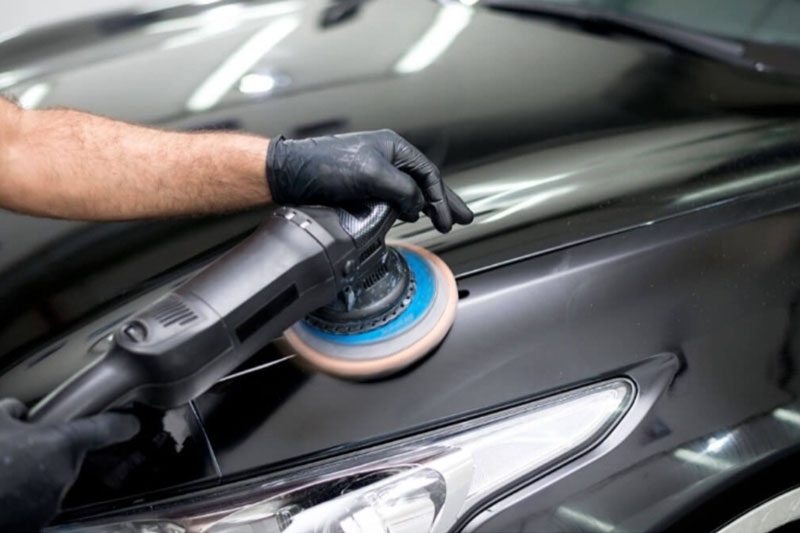
When water spot etching remains after mineral removal, machine polishing may be necessary.
This is a paint correction process rather than a cleaning procedure.
Understanding Automotive Paint Correction
Modern automotive paint generally includes a colour basecoat protected by a transparent clear coat.
Etched water spots affect the upper surface of this protective layer.
Paint correction uses controlled abrasion to level minor defects and improve the finish.
A professional should inspect the paint thickness and condition before deciding whether correction is appropriate.
Serious damage may not be safely removable through polishing alone.
Choosing Between DA and Rotary Polishers
Dual-action (DA) and rotary polishers are commonly used for automotive paint correction.
A DA polisher generally offers a more forgiving approach for many correction tasks.
Rotary machines provide direct rotational movement and can achieve efficient correction in experienced hands, but they require careful control.
The appropriate machine depends on the paint condition, defect severity, and technician's experience.
Selecting the Right Foam Pad and Polishing Compound
Different polishing pads and compounds offer different levels of cutting ability.
A fine finishing polish with a soft foam pad may be sufficient for light defects.
More stubborn etching may require a stronger combination, followed by a refining step to restore clarity and gloss.
Always start with the least aggressive combination that achieves the required result.
The Risks of Over-Polishing in Dubai
Excessive polishing removes unnecessary clear coat and can compromise long-term paint protection.
High panel temperatures also make paint correction more challenging.
Professional technicians should work in controlled conditions, monitor panel temperatures, and avoid repeated correction without assessing the remaining paint thickness.
Advanced Protection: Shielding Your Finish from Dubai's Elements
After water spot removal, suitable paint protection helps simplify future maintenance.
Ceramic Coatings and Mineral Deposits
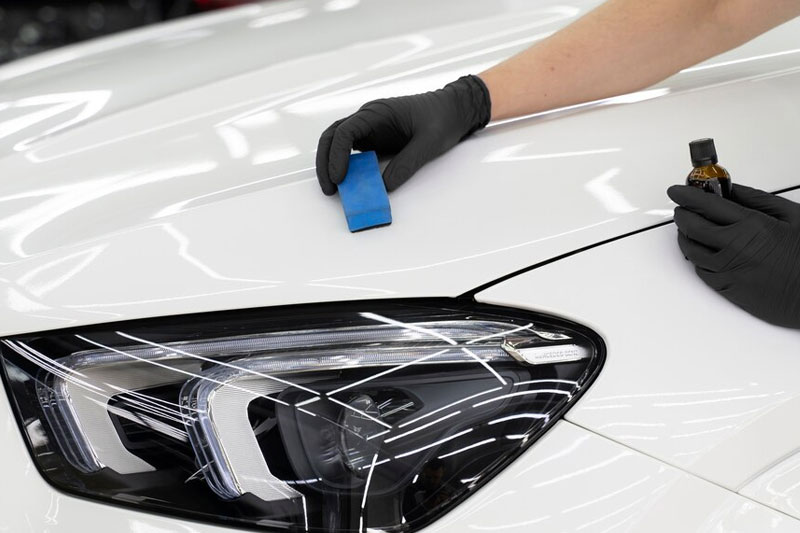
Ceramic coatings create a protective layer over automotive paint and can improve hydrophobic performance.
Water beads and may run off more easily, reducing the time moisture remains on the surface.
However, ceramic coatings are not completely water-spot-proof. Minerals can still dry on coated surfaces and may create deposits or etching if neglected.
Understanding how to remove water spots from ceramic coating safely is particularly important. Use coating-compatible products and avoid aggressive polishing without assessing the coating first.
Paint Sealants vs. Car Wax
Both wax and paint sealants provide additional surface protection.
Wax generally offers a traditional protective finish, while synthetic sealants are formulated for durability and resistance to environmental exposure.
Neither eliminates the need for proper washing and drying.
The right option depends on the vehicle's usage, maintenance routine, and desired appearance.
Maintaining Existing Ceramic Protection
If your vehicle already has a ceramic coating, regular maintenance helps preserve its hydrophobic characteristics.
Use appropriate maintenance shampoos, coating-compatible decontamination products, and recommended booster treatments.
Do not assume that reduced water beading always means the coating has failed. Surface contamination can interfere with its performance.
Best Practices for Water Spot Prevention in the UAE
Preventing water spots is easier than repeatedly correcting paint damage.
The Distilled Water Rinse Technique
Using filtered or demineralised water for the final rinse can reduce the amount of dissolved mineral residue left behind.
This can be particularly useful when your regular washing water has a high mineral content.
Combatting the Dubai Sprinkler Effect
Automatic irrigation systems can expose parked vehicles to repeated water droplets.
Whenever possible:
- Avoid parking near active sprinklers.
- Choose covered parking.
- Report incorrectly positioned irrigation systems.
- Remove fresh water deposits before they dry repeatedly.
Professional Drying Techniques
Dry your vehicle immediately after washing using clean, absorbent microfiber towels.
A suitable automotive air blower can help remove water trapped around mirrors, badges, grilles and trim.
Avoid allowing water to evaporate naturally across the bodywork.
Why You Should Never Let Your Car Air Dry
Air drying leaves mineral deposits behind when the water contains dissolved solids.
This is particularly noticeable on black, dark blue, and other dark-coloured vehicles.
Proper drying is one of the simplest ways to reduce recurring water stains.
Essential Tools for Maintaining Your Car's Paint
Having the correct maintenance equipment can help prevent unnecessary paint damage.
| Tool | Purpose |
|---|---|
| High-GSM microfiber towels | Safe washing and drying |
| pH-neutral car shampoo | Routine exterior cleaning |
| Automotive water spot remover | Dissolving suitable mineral deposits |
| Clay bar and lubricant | Removing bonded surface contamination |
| Paint-safe polishing compound | Correcting suitable etched defects |
| Dual-action polisher | Controlled paint correction |
| Water filtration system | Reducing minerals in wash water |
| Ceramic maintenance spray | Supporting existing paint protection |
Always choose products according to the vehicle's paint type and protection system.
Professional Water Spot Removal in Dubai: Why Choose Safalux Auto Care?
Persistent water stains require more than repeated washing. They require the correct diagnosis and treatment.
Safalux Auto Care provides automotive paint services in Dubai, with its workshop located in Al Quoz.
Our published service information highlights professional surface preparation, skilled technicians, and attention to automotive paint finishes.
When dealing with water spot damage, the appropriate treatment should be selected according to the condition of the vehicle.
Whether you drive a luxury car, family SUV, sports car, or daily commuter, preserving the original paint finish should remain the priority.
Why consider Safalux Auto Care?
- Professional automotive paint care.
- Attention to vehicle surface preparation.
- Treatment selection based on paint condition.
- Focus on maintaining exterior appearance.
- Convenient Al Quoz workshop location.
Do not allow stubborn water stains to affect your vehicle's appearance. Get your paintwork professionally assessed and find the right treatment for your car.
Book Your Water Spot Removal Service in Dubai Today!
Contact Safalux Auto Care to discuss your vehicle's paint condition and arrange a professional assessment.
Visit our workshop in Al Quoz, Dubai, and take the next step towards restoring your vehicle's clean, glossy finish.
Call: +971 52 10 444 93
Email: info@safaluxauto.care
Website: https://safaluxauto.care/
Final Thoughts: Keep Your Car's Paint Spot-Free in Dubai
Water spots may initially look like simple mineral stains, but prolonged exposure can affect the clear coat and reduce your vehicle's shine.
The best approach is to identify the damage before choosing a treatment. Chemical decontamination is suitable for many surface deposits, while mechanical correction may be required for genuine etching.
With appropriate washing, drying, and paint protection, you can reduce the risk of recurring stains and maintain a cleaner exterior.
For professional automotive paint care in Dubai, contact Safalux Auto Care and arrange an assessment of your vehicle.
Recent Posts