Date: 05-June-2026 Author: Safalux
Table of Contents
- Understanding Ceramic Coating: Beyond Traditional Wax and Sealants
- The Ultimate Shield: Protection Against Environmental Damage
- The Aesthetic Advantage: Achieving a Permanent Showroom Shine
- The Hydrophobic Effect: The Magic of Water Beading and Repellency
- Maintenance and Sustainability: An Eco-Friendly Approach to Car Care
- Maximizing Your Investment: The Financial Case for Coating
- The Critical Role of Surface Preparation
- Professional Application vs. DIY: Understanding the Stakes
- Reality Check: Managing Expectations for New Owners
- Post-Application Care: The First 24 Hours and Beyond
- Conclusion: The Verdict on Ceramic Protection
- Frequently Asked Questions
Most service pages on ceramic coating for cars tell you the same thing: it's shiny, it repels water, and it lasts years. What they rarely cover is why it works, what it genuinely can and cannot do, and what separates a world-class application from an average one. This page fills every one of those gaps.
Whether you've just bought a new car, own a luxury vehicle in Dubai, or simply want to stop spending every weekend washing road grime off your paint, this is the most thorough guide you'll find. We'll walk you through the science, the process, the real benefits, and the honest limitations — so you can make the best decision for your vehicle.
Understanding Ceramic Coating: Beyond Traditional Wax and Sealants
If you've ever wondered why your freshly waxed car looks dull again after a few weeks, you're not alone. Ceramic coating for cars solves exactly that problem - and then some.
The Science of Nanotechnology: How Silicon Dioxide (SiO2) Works
Ceramic coatings are made of silicon dioxide (SiO2), which is a chemical made from quartz. When it's applied as a liquid, it is made up of nanoparticles -particles that are so tiny they fill the microscopic pores of the clear coat of your car. The result is a finish that is smooth on an atomic level and resists adhering to the contaminants.
It's not a surface layer that is set on top of the paint. It is a sealant that fills in and then becomes its own surface. This is what makes the automotive ceramic coatings distinct from other wax products available that you can buy.
How a Liquid Polymer Creates a Permanent Chemical Bond with Your Clear Coat
After being put on, the liquid polymer goes through the curing process, which creates covalent bonds with the transparent coating underneath. It's less like paint, and more of an extra skin one that binds on the molecular level, and won't disappear with the rain or with shampoo.
This mechanism of bonding is the reason professionally applied paint could last from two to nine years, based on the tier of product used and the extent to which it is kept.
Comparing Longevity: Why Waxes Fail Where Ceramic Coatings Excel
Carnauba wax makes a stunning product -- no doubt there. However, it begins to break down within weeks after being exposed to heat, UV light, and water. Paint sealants are more effective, generally lasting between three and six months, yet they will still degrade slowly.
The coating on vehicles, in contrast, is able to withstand the rigors of seasons. The climate in Dubai, which is where temperatures in summer often exceed 45degC, and UV indexes are among the highest in the world. This durability isn't merely a marketing ploy. It's an absolute requirement.
The Ultimate Shield: Protection Against Environmental Damage
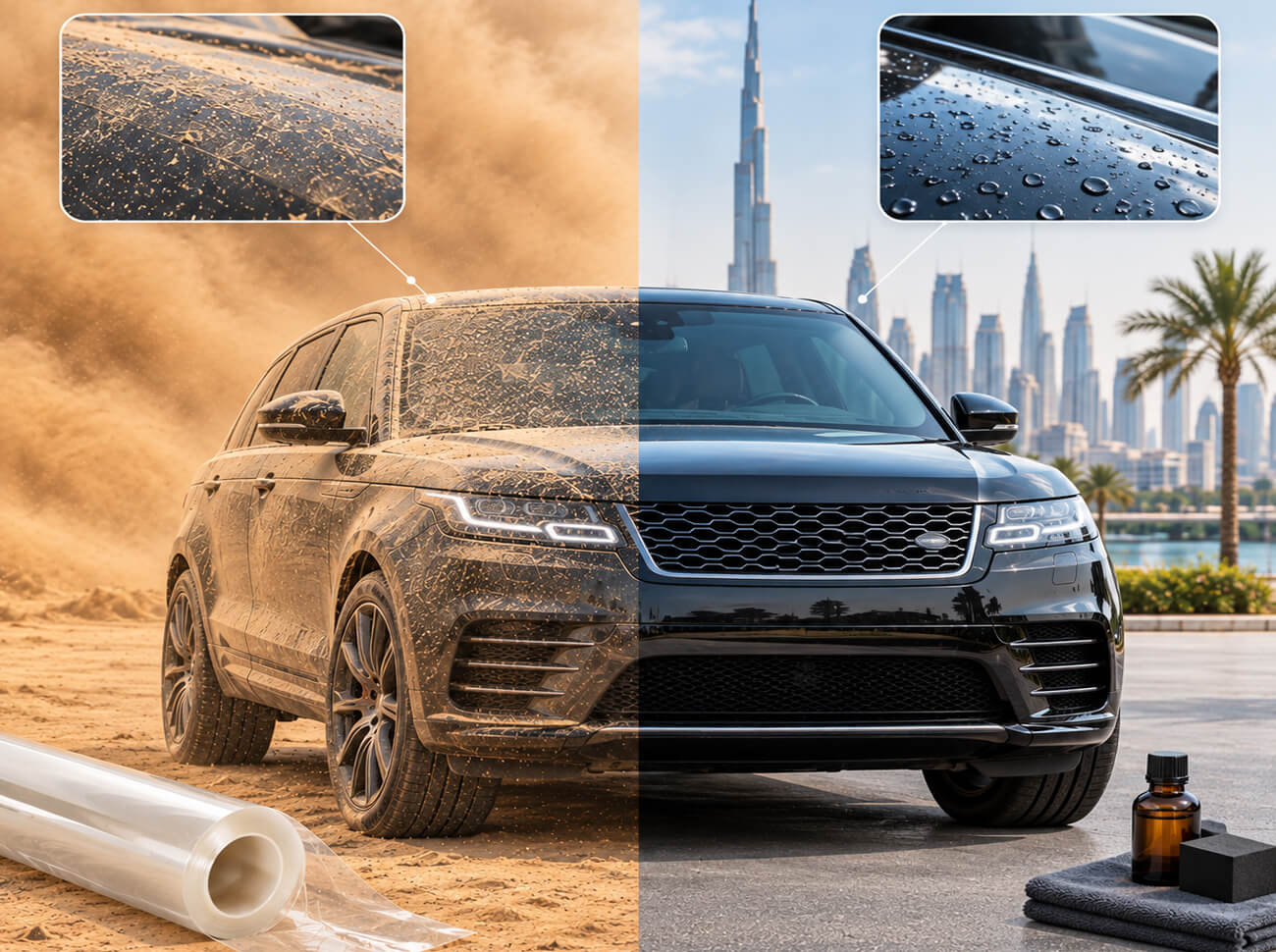
Dubai is among the most difficult environments for painting in the world. Knowing what your car is exposed to daily makes the argument for protecting your paint with ceramic virtually impossible to argue with.
Guarding Against UV Fading and Paint Oxidation
Ultraviolet radiation is the leading cause of paint oxidation as well as color loss in climates with high sunshine. Clear coat that is not properly protected breaks down on the molecular level when exposed to UV for long periods of time, which is slow and invisible. It is inexplicably irreversible if you don't make a complete paint correction.
A good car ceramic coating has UV-blocking substances that block and block sunlight before it reaches the surface of the paint. Your color will remain more vibrant, your gloss will get higher, and your painting is able to age more easily.
Chemical Resistance: Neutralizing Bird Droppings, Tree Sap, and Acid Rain
The bird droppings contain acid. The sap of trees is corrosive and sticky. Acid rain, especially common in industrial areas, smudges paint that is not protected within hours of being placed on hot surfaces. This isn't a rare event -they're everyday occurrences for all cars that are parked outside in Dubai.
Ceramic coating is an anti-chemical barrier. The contaminants that normally be etched to clear coat sit on the top of the coating, which makes them much easier to clean off before damage is caused.
Preventing Corrosion and Damage from Road Salt and Industrial Fallout
If you are driving close to ports, industrial areas, or construction sites, as well as in Dubai, this is the case for most people -- then your vehicle will be exposed to metal particles as well as airborne debris that settle onto the paintwork, and then begin to oxidize immediately. Protecting paintwork on cars through a ceramic coating blocks particles from contacting the surface of the panel.
The result is a finish that stays clear between washes, is resistant to micro-corrosion, and lasts better over time than any non-protected vehicle.
The Aesthetic Advantage: Achieving a Permanent Showroom Shine
One of the most immediate ceramic coating benefits that new owners notice - sometimes within minutes of delivery - is the sheer depth of the finish.
Enhancing Color Depth and Gloss Units for a Mirror-Like Finish
Ceramic coating does more than protect paint, but enhances it. The SiO2 coating fills in imperfections on the surface and produces an ultra-flat and ultra-reflective surface. The gloss readings from meter readings on vehicles coated with SiO2 regularly surpass those of factory-fresh paint.
Dark shades like deep blues, blacks, and rich reds are amazing. The wet-look depth that you get on show automobiles? This is what a properly applied ceramic coating provides when you drive.
The Role of Light Reflection in High-End Paintwork
Paints for cars reflect light through thousands of microscopic peaks and valleys. The smoother and flatter its surface is, the more uniform the reflection and the greater the visual impact. Ceramic coating smooths these peak areas at a nano-level, which creates what experts in detailing call "candy-like" clarity in the surface.
Why Ceramic Coating Outperforms Sealants for Luxury Vehicle Presentation
For performance and luxury automobile owners in Dubai, the quality of appearance is important. Sealants wear off, require frequent repeat application, and do not provide the same look. A properly applied ceramic coating keeps its shine and luster for many years and keeps your car looking like it's just come out of the dealership - every day.
The Hydrophobic Effect: The Magic of Water Beading and Repellency
If you've never seen a ceramic-coated car in the rain, you're in for a treat. Water doesn't spread across the surface - it beads instantly and rolls off in tight droplets, taking dust and grime with it.
Understanding the Self-Cleaning Mechanism: How Dirt and Gunk Slide Off
The technical term is "lotus effect." The hydrophobic coating reduces the adhesion between water molecules as well as the coating to such an extent that water's physical structure is not able to smooth out. As it goes off, it sifts particles of dirt -- pollen, dust, and light grime, etc. in the process.
Self-cleaning is best apparent after rain or an easy rinse. In uncoated vehicles, water sits on the ground, then evaporates and creates mineral deposits. When coated, the vehicle is clean and does not carry any contaminants along with it.
Why Hydrophobic Properties Make Car Washing Significantly Faster
Since dirt is less adherent to a surface coated with a coating, washing time is reduced. The contaminants that used to require multiple cycles with a wash glove can now be cleaned away with little effort. Professionals with busy schedules do not wish to devote hours to cleaning their cars; it is one of the most useful ceramic coating advantages in daily use.
Reducing the Risk of Water Spotting and Mineral Deposits
Dubai's water supply is high in mineral levels. When water evaporates on paint that is not protected, it forms magnesium and calcium deposits- these chalky white spots that require a lot of effort to get rid of. The hydrophobic coating's surface reduces the amount of time that water remains on the panels, significantly decreasing the speed at which water spots develop.
Maintenance and Sustainability: An Eco-Friendly Approach to Car Care
Here's something most detailing companies won't tell you: ceramic coating is genuinely better for the environment, not just your car.
The End of Harsh Chemicals: Why You Only Need pH-Balanced Shampoos
After your car is fully covered, you can remove the abrasive cleaning and degreaser. A pH-balanced shampoo for your car and pure water are all you need for regular maintenance washes. Fewer chemicals mean less environmental impact and a lower risk of degrading the coating.
Sustainability Benefits: Reducing Water Consumption During Maintenance
Coated vehicles require fewer passes, fewer refills of the bucket, and less frequent rinse cycles. Over the course of months and years, the total savings over routine maintenance is significant. In a country such as the UAE, in which water conservation is a major issue, this is a real-world merit to be acknowledged.
The Efficiency of the Foam Cannon and Microfiber Towel Method
The most effective maintenance procedure is easy: rinse to get rid of dirt from the surface, then apply a foam cannon using pH-balanced shampoo, gentle stirring with the soft wash mitt, rinse, and dry with an unclean microfiber towel. No abrasive pads, no harmful chemicals, and no danger of contaminating the coat. Fast, efficient, and safe for coatings.
Maximizing Your Investment: The Financial Case for Coating
A professionally applied ceramic coating is one of the smartest financial decisions you can make as a car owner - especially in Dubai's competitive resale market.
Preserving Resale Value through Long-Term Paint Protection
When the time comes to trade or sell your car, the condition of its paint is among the first factors a prospective dealer or buyer will look at. A vehicle with clean, well-protected, and beautiful paintwork will fetch a higher price than one that has swirl marks, oxidation, or faded panels.
Ceramic coating on cars locks in the paint's quality starting from the first day. In the event that you put it on the new car after the correction of paint, you're sealing the finish to its optimal condition for a long time.
Cost-Benefit Analysis: Initial Professional Application vs. Years of Detailing
A couple of times a year for waxing as well as making sure paint corrections are made or replacing faded trim, managing water spot removal -these expenses add up. A high-quality ceramic coating is a one-time investment that replaces years of reactive maintenance.
If you break the cost into a five-to nine-year period, it is clear that the math favors coating. It is cheaper over the course of time, and also your vehicle appears better throughout.
Protecting Specialized Surfaces: Gtechniq C5 Wheel Armour and Trim Coatings
Paint isn't just one surface to be protected. Wheels collect brake dust when they reach high temperatures. The trim pieces fade when exposed to ultraviolet light. Glass causes water spotting, which reduces visibility.
Professional-grade products like Gtechniq C5 Wheel Armour apply the same technology of ceramic bonding to calipers and alloys, stopping the effects of heat, adhesion to brake dust, as well as road grit at the panel level. Glass coatings enhance visibility in wet weather and help reduce wear on the wipers. Comprehensive protection packages cover the entirety of the vehicle, not just the bodywork.
The Critical Role of Surface Preparation
Here is where most DIY attempts - and some professional applications - fall short. Surface preparation is not a step you can rush or skip. It is the foundation on which everything else depends.
Deep Decontamination: Why a Professional Detailer Uses Clay Cloths and Iron Removers
Before applying any coating, the paint has to be physically and chemically cleaned. That's why iron remover spray is used to dissolve metallic particles embedded in the paint, followed by clay cloths or a clay bar to get rid of the bonded contaminants, which a wash isn't able to touch. By skipping this step, you trap the contamination underneath the coating, where it'll remain, degrading the paint beneath.
The Necessity of Machine Polishing and Paint Correction Before Coating
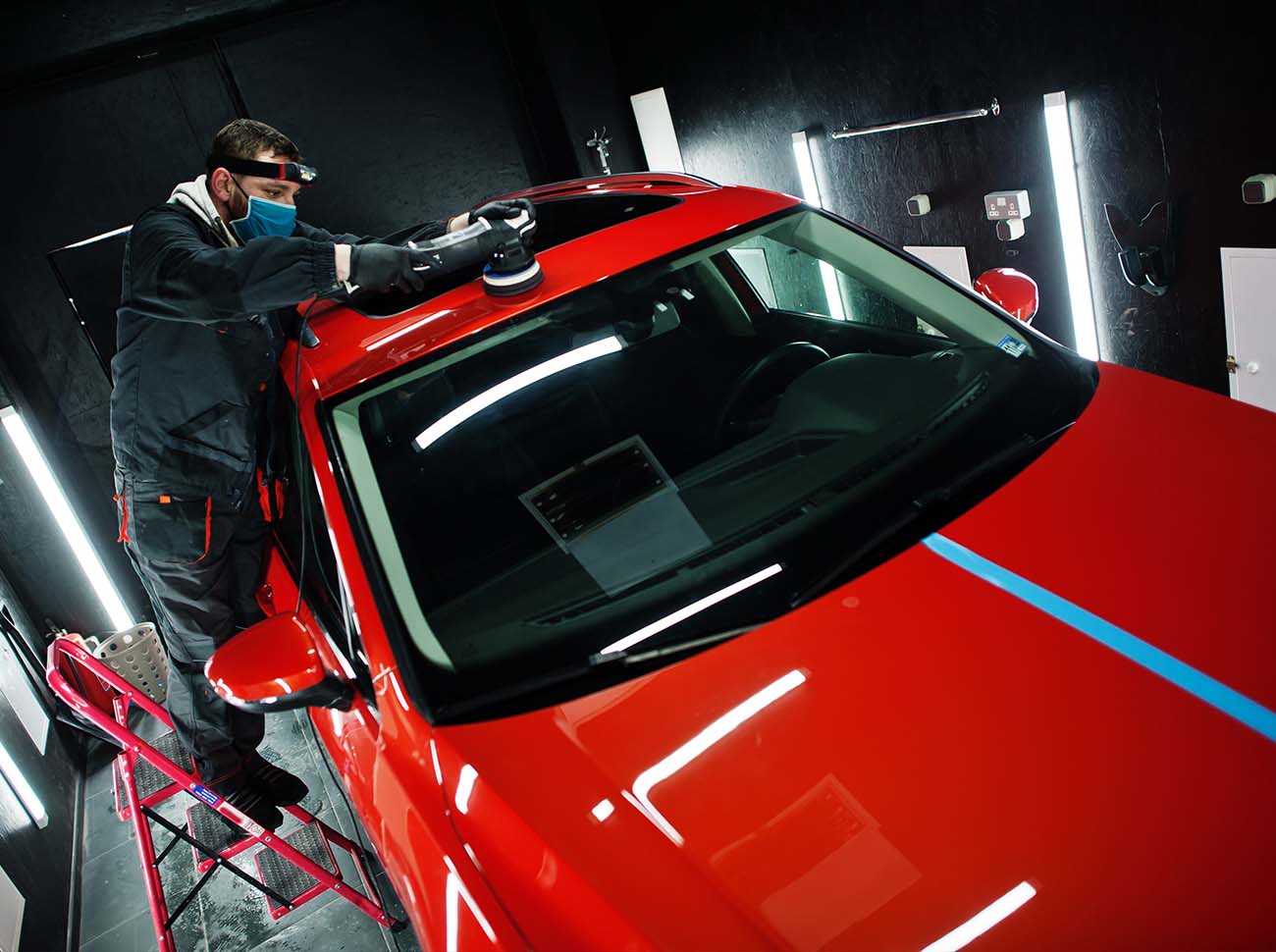
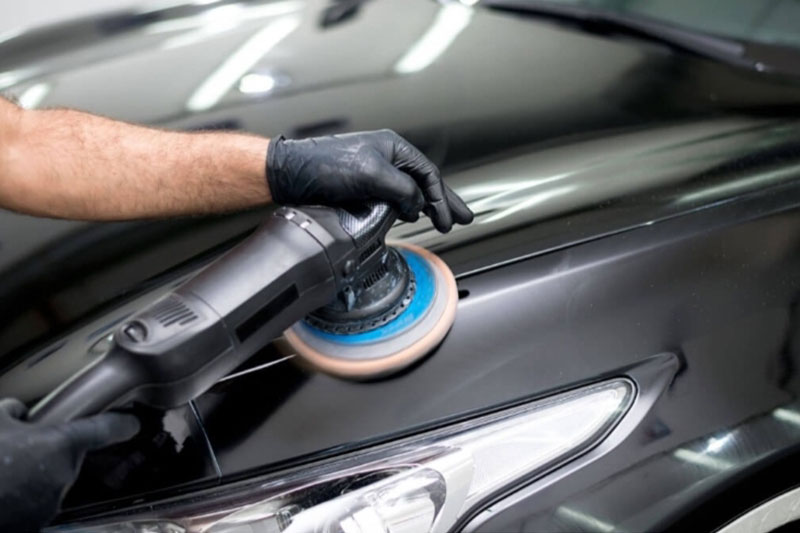
The coating of ceramic is transparent. Anything visible in the paint when the coating is removed - swirl marks, scratch marks, or water-etched- will be protected underneath it, for the rest of time. The correction of paint with a rotary polisher with dual-action takes away the defects before they're fixed in.
This is the reason why the preparation phase is often longer than the application. If done correctly, this is what differentiates an excellent score from a poor one.
Panel Wipes and Prep Sprays: Ensuring the Perfect Coating Bond
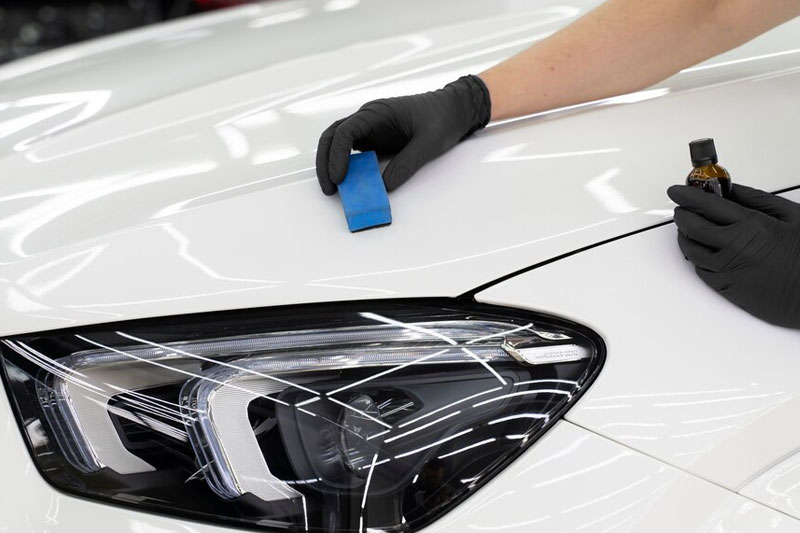
After polishing, the panels are then cleaned using the IPA (isopropyl alcohol) prep spray to eliminate any polish residues, oils, or silicones that might hinder chemical bonding. Only after that the surface is free of oil, clean, and decontaminated, does the coating take place. In a controlled, closed area, far from the humidity and dust.
Professional Application vs. DIY: Understanding the Stakes
Consumer-grade ceramic coating kits are widely available. Some of them are genuinely decent products. But the application process is where the gap between professional and DIY results becomes very clear, very quickly.
The Importance of a Controlled Environment for Curing
Ceramic coating starts curing upon exposure to air. Temperature, humidity, and dust in the air all influence the extent to which it is cured. Professional studios apply coatings in closed, climate-controlled spaces to avoid these issues. The application of coating outdoors or under direct sunlight or with high humidity can lead to streaking, high spots, or uneven bonding, which is difficult to correct following the event.
9H and 10H Hardness: Fact vs. Fiction in Paint Protection
You'll find "9H hardness" on almost every ceramic coating label, from kits for budget to professional levels. The rating of hardness is based on the scale of hardness for pencils, an indicator of scratch-resistant properties at the surface level. It doesn't mean the coating is scratchproof, and a higher value does not guarantee more durability.
What is more important than the rating of the hardness is the quality of the chemistry used, how the coating is prepared, and the skills of the person applying. A 9H rating on a poorly prepped surface that has poor application techniques is less than a properly applied mid-tier coating each time.
Why Professional Grade Products (Ceramic Pro, G-Techniq, Modesta) Outlast Retail Kits
Professional-grade products such as Ceramic Pro, Gtechniq Crystal Serum Ultra, and Modesta are designed for experienced applicators. They are formulated with chemistry to ensure the highest endurance and durability as well as bond strength. They are not offered to the general public since proper use requires meticulous control and experienced hands.
If you decide to purchase an expert ceramic coating service from Safa Lux Auto Care, you're receiving an environmentally friendly product and the experience, not just a container of product that is applied in uncertain conditions.
Reality Check: Managing Expectations for New Owners
Every first-time coating buyer deserves honest information. Ceramic coating is exceptional. It is also not invincible - and knowing the difference protects your expectations and your investment.
Why Ceramic Coatings Are Not a Shield Against Rock Chips and Dents
Ceramic coatings provide toughness and chemical resistance to any clear coat. It does not increase the thickness. A stone chip traveling at highway speeds has enough energy to cut through clear coats from the factory, primer, and paint. Ceramic coating won't stop this from happening.
If protecting yourself from physical damage and stone chips is what you want, Paint Protection Film (PPF) is the solution you require - and it works beautifully when combined with ceramic coatings that are layered over.
Resistance to Minor Scratches and Micro-Swirls vs. Total Invincibility
Ceramic coating is able to resist micro-marring due to improper wash techniques better than paint that is bare. It also reduces the severity of small scratches caused by gentle contact. However, it's not scratch-proof. Scrubbing with abrasive materials, aggressively scrubbing, or automatic car washes that use rigid brushes will not completely remove the surface.
The key takeaway is to keep your vehicle with the correct cleaning techniques, and your paint will remain gorgeous for a long time. Don't neglect it, and no coating, regardless of name or the hardness rating, can be protected for as long as you want.
The Truth About "Never Washing Your Car Again"
Certain marketing claims suggest that coatings help clean themselves. It's a lie. Washing indeed becomes much simpler, faster, and less frequently than painted paint that is not protected. There will be a need for regular maintenance washes - however, you'll not be anxious about them any longer.
Post-Application Care: The First 24 Hours and Beyond
Getting the application right is only half the equation. How you treat your vehicle in the hours and days after application directly affects the long-term performance of the coating.
Navigating the Curing Phase: Avoiding Moisture and Contaminants
In the initial up to 24 hours following application, the coating continues to cure chemically. During this time period, it is essential that the vehicle remains clear of dirt and moisture. It is not necessary to expose the vehicle to rain, there are no car washes, and no bird droppings left in the car to remain. Even water droplets in this time frame will leave marks after the coating is set.
Your detailing expert will provide you with a curing time dependent on the coating used and the ambient conditions. Be sure to follow it precisely; the curing phase creates the bond strength, which allows the coating to last.
Routine Inspections: When to Apply a "Top-Up" Layer like Gyeon Q2 Cancoat or CarPro Gliss
Professional-grade coatings are able to be refreshed by a sacrificial top coat product such as Gyeon Q2 Cancoat and CarPro Gliss that are placed over the base ceramic every 12 to 24 months. These top coats can restore hydrophobicity, create a fresh layer of gloss, and prolong the life of the coating without an entire renewal.
Consider it an occasional service, not an entire replacement. A quick check and a top-up visit to Safa Lux Auto Care will determine if your coating is still performing well or would be in need of an upgrade.
Why Maintenance Washes Still Matter for Coating Longevity
A surface that is not in good condition -- contaminated by bird-dropping etching, bonded contamination, or mineral deposits-- is more likely to degrade and lose hydrophobic properties faster. Regular cleaning using pH-balanced shampoo ensures that the surface is clean on a chemical level, not only visually.
Minimum monthly washes are recommended. It is recommended to wash twice a week for motorists in Dubai. It can take 30 minutes if you use the correct method, and it also prolongs the time your coating performs in its top form.
Ready to Protect Your Vehicle? Book with Safa Lux Auto Care
Your car is one of your most significant investments — and in Dubai, where UV, dust, industrial fallout, and heat test paintwork every single day, proper protection isn't optional. It's essential.
At Safa Lux Auto Care, we bring meticulous preparation, professional-grade products, and a genuinely customer-first approach to every ceramic coating application. Whether you're protecting a brand-new daily driver, preserving the finish on your luxury vehicle, or preparing your car for resale, we tailor the right solution to your vehicle and your goals.
Don't leave your paintwork unprotected. Contact Safa Lux Auto Care today to book your free inspection and receive a tailored quote for ceramic coating in Dubai.
📍 A34 street - Al Qouz Ind. first - Al Quoz - Dubai - | 📞 Call or WhatsApp for a same-day quote
Conclusion: The Verdict on Ceramic Protection
Why Modern Automotive Paint Requires Advanced Protection
Factory clear coat was never designed to handle the demands of Dubai roads alone. UV radiation, chemical fallout, heat cycling, desert dust, and abrasive particles combine to degrade unprotected paint faster than most owners realize. Ceramic coating for cars isn't a luxury add-on - it's the modern solution to a very real, ongoing problem.
Final Thoughts: Transforming Your Vehicle Ownership Experience
Ceramic coating changes how you feel about your car. Washing becomes easier, the finish stays sharper, and you drive with confidence knowing your paintwork is genuinely protected. For new car owners, luxury vehicle enthusiasts, busy professionals, and anyone who values what they drive, it is one of the most rewarding investments you can make from day one.
Recent Posts